A Simple Principle

AI & Learning

Schools should prepare students for a world shaped by artificial intelligence—without sacrificing independent thinking, student privacy, or the essential role of educators.

Use AI as an assistant. Keep people responsible.

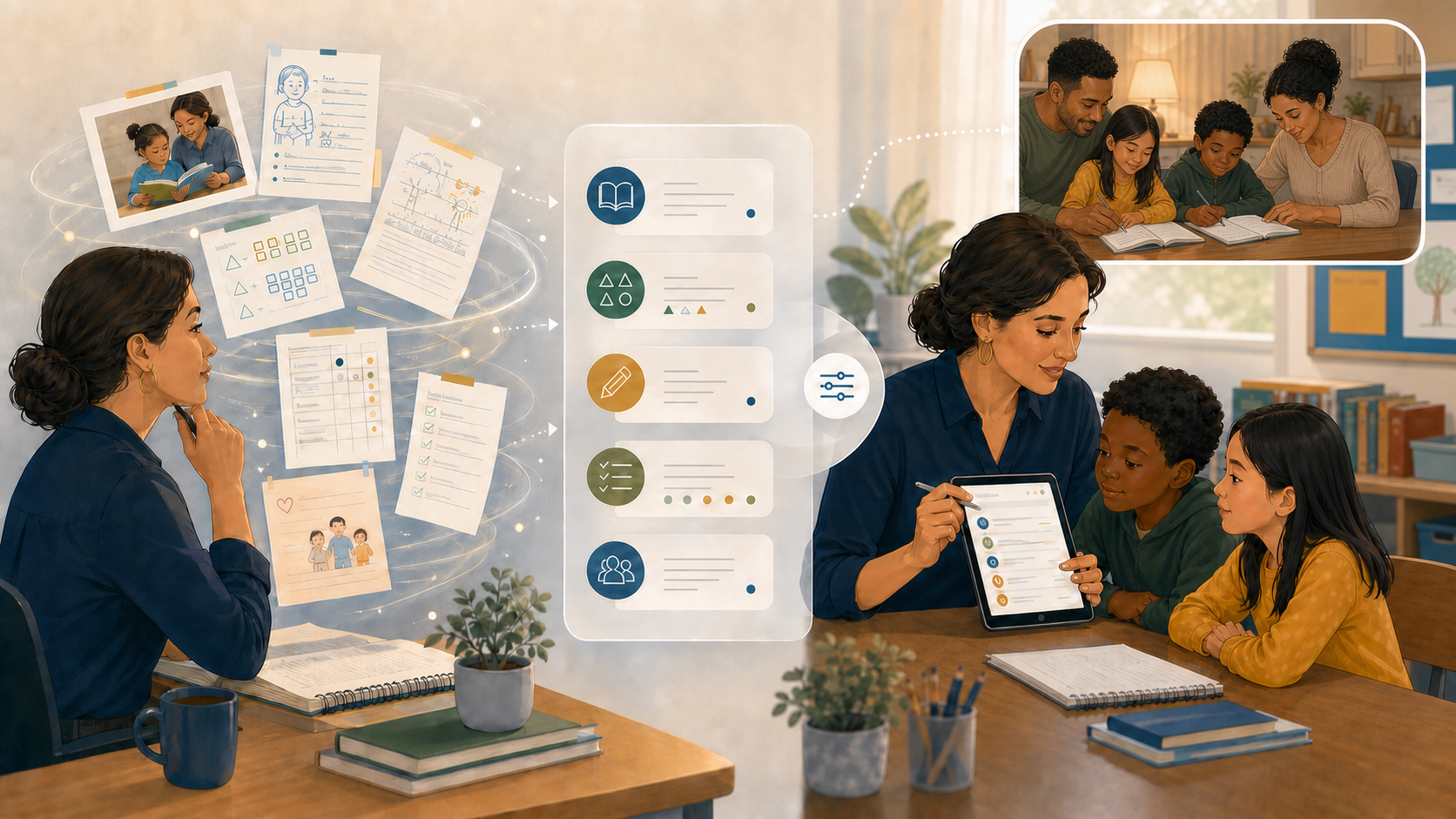
A K–8 teacher using a quiet digital organizing aid to review student work, with a separate home vignette showing two parents helping a girl and boy with homework

A Theoretical Application

Could AI give teachers more time to teach?

This concept grew from my Stanford AI coursework and capstone thinking. It is not a proposal for district adoption or a claim about how our schools currently use AI. It is an example of a question worth exploring with educators and families.

In the early grades, assessment is rarely a stack of essays. It is the daily work of observing children, reviewing reading and math progress, organizing work samples, documenting growth, completing report cards, and communicating with families.

One concept to examine. With strong privacy protections, could an educator-designed tool help organize teacher observations and student work over time—without training commercial AI models or creating permanent labels?
Prepare—not deliver—feedback. AI could draft a progress summary or family communication for the teacher to check, revise, and personalize.
Teachers make every final judgment. AI should never independently evaluate a child, assign a grade, or replace professional knowledge of the whole student.

A possibility to investigate—not a product to pitch. The goal would be less paperwork and more individual attention, never larger classes or fewer educators.
Why “Assistant”?

A lesson from my own classroom experience.

In college, I served as a teaching assistant for my theology professor. I reviewed student papers and recommended grades, but the professor established the assignment, supervised the process, and remained accountable for every final decision.

That experience shapes my view of AI: it may help prepare a first review, but it cannot assume an educator's judgment, authority, or responsibility.

AI can assist with assessment. It cannot assume the authority or accountability of an educator.

Grow capability without losing our roots.

Start with a real educational need. Keep educators and families involved. Grow only what strengthens learning.

Share Your Perspective

Why I Studied AI

Curiosity grounded in ethical responsibility.

My interest began after I saw a billboard along Highway 101 promoting the idea of making AI productive—and turning it into a product. The language stopped me. My theological perspective led me to ask a broader question: as these systems become more capable, what responsibilities should guide the way people design, sell, and use them?

I believe ethical reflection should develop alongside technical capability—not arrive after consequential choices have already been made.

  • A Crash Course in Artificial Intelligence: Parts I & II
    Stanford Continuing Studies
  • AI-Powered Product Innovation
    Certificate Course, Stanford University School of Engineering

Applied Learning

Building with human judgment at the center.

For my Stanford capstone, I developed ShopAssist, an AI prototype designed to organize information while keeping people responsible for every consequential decision.

I have also built TacodogAI, a locally controlled knowledge system based on my own writings. Both projects reinforced the same lesson: AI is most useful when it assists people without obscuring uncertainty or replacing accountability.

Learn Together

Guidance informing this perspective.

These public resources offer a useful starting point for understanding AI in schools. They emphasize educator involvement, student privacy, transparency with families, equity, and human accountability.

The theoretical application above is an invitation to ask better questions. Any local next step should begin by listening to San Carlos educators and families.